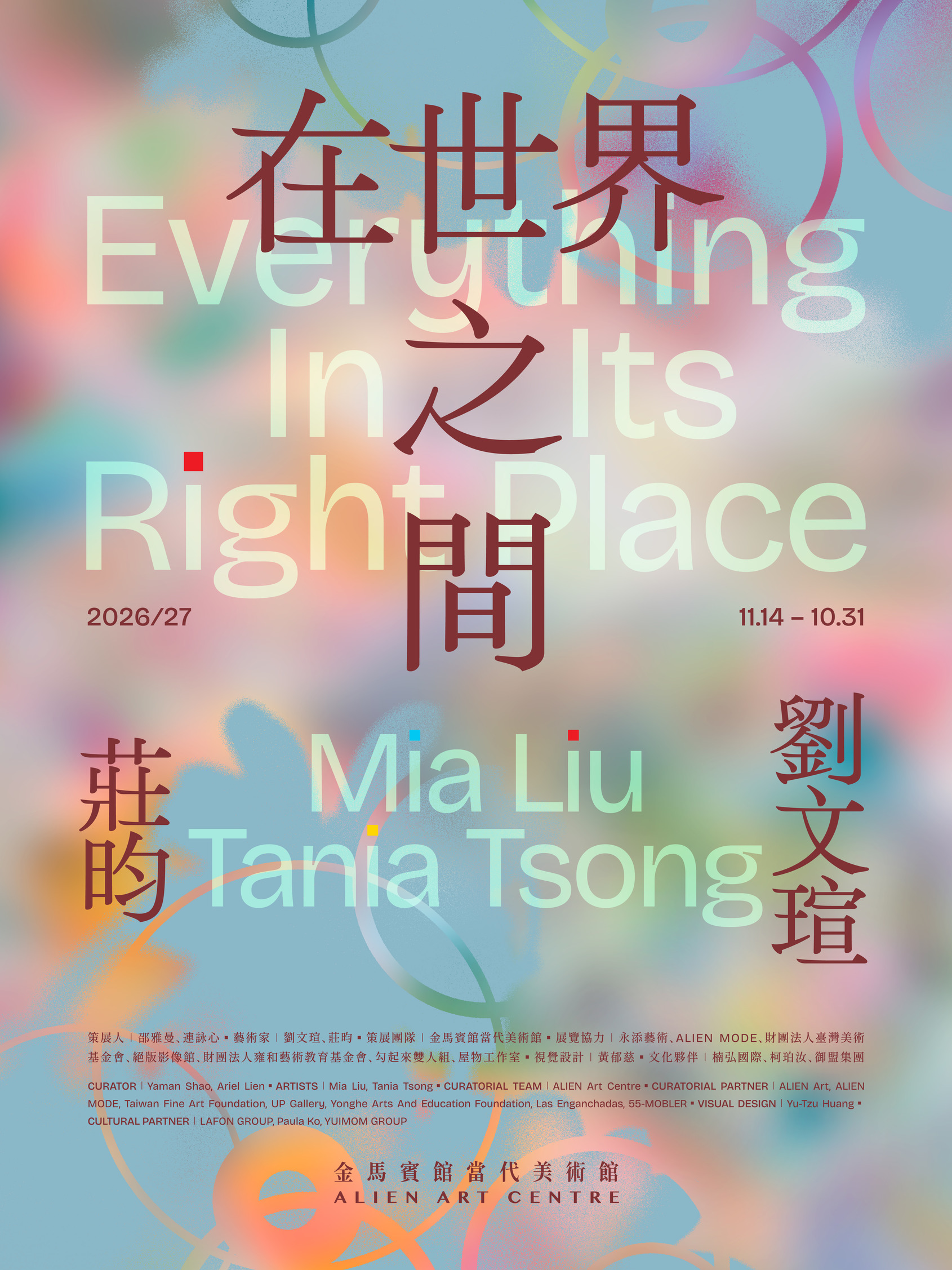
When things leave their original places, do we begin to see the world differently?
The exhibition's English title, Everything in Its Right Place, is borrowed from a song released in 2000 by the British band Radiohead. At first, the phrase suggests a definite order: everything is in its “right” place. Yet the song's repetitive, electronically processed vocals, layered electronic sounds, and unresolved musical structure evoke a sense of unease. “Everything in its right place” begins to sound like a statement repeated in search of certainty, yet never fully assured. Language declares that order has been established, while perception remains unsettled.
This contradiction becomes the starting point for understanding the notion of “place” in Everything in Its Right Place.
Here, right does not imply an absolute sense of correctness, but rather a sense of fittingness—of things temporarily finding a place where they can exist in relation to one another. When objects, materials, images, and ways of seeing are removed from their original contexts, displaced, deconstructed, and reassembled, they enter new relationships and acquire different meanings. The right place is therefore not a return to the point of origin, but a process of repositioning amid change. Deconstruction is also a form of reconstruction.
This idea resonates with the notion of “between” in the exhibition's Chinese title, 在世界之間. The artificial and the natural, the microscopic and the macroscopic, the two-dimensional and the three-dimensional, reality and imagination—these are not fixed oppositions in the practices of Mia Liu and Tania Tsong de O’pazo, but fluid states that can be traversed and transformed. Art emerges within these boundaries, and through the continuous movement of things from one state to another.
For Tania Tsong de O’pazo, the idea of place is closely intertwined with her experiences of living across different geographies. With familial roots in Taiwan and Spain, and having lived in Brazil, India, China, and Turkey, questions such as “Where am I?” and “Where do I belong?” have become ways of seeing the world. Maps, distance, memory, and everyday objects recur throughout her practice. Images move from two dimensions into three, while objects freed from their original functions invite new associations. Her creative process resembles a form of wandering, less concerned with reaching a destination than with discovering what things might become through transformation. The world is no longer defined by fixed coordinates, but continually rediscovered through the intersections of culture, memory, and experience.
For Mia Liu, place emerges through encounters between the body, materials, and space. Working with everyday materials and spatial experiences, she employs cutting, joining, layering, extending, and reconfiguration to transform familiar forms and scales. Two-dimensional surfaces extend into space, while materials shift in appearance according to the viewer's movement, distance, and perspective. Her works offer no single, fixed point of view; instead, they take shape through the ongoing interaction between body and space. Her practice reminds us that looking is never neutral. A change in position also changes the world we see.
The two artists approach Everything in Its Right Place from different directions. Tsong de O’pazo begins with the movement of geography, culture, and memory, while Liu explores shifts in the body, materials, and the position of the viewer. The former allows familiar things to acquire new meanings across cultures; the latter makes established forms and spatial relationships unfamiliar once again. Rather than seeking to restore an existing order, both artists loosen seemingly stable relationships, allowing other possibilities to emerge.
What makes this exhibition distinctive is the encounter between two different artistic languages.
As different modes of perception and spatial expression converge within the same building, looking is no longer confined to individual artworks. Moving between the works, viewers compare, sense, and gradually become aware of shifts in their own ways of seeing. The experience prompted by one work may carry over into another, while materials and scales take on different meanings as the surrounding space changes. The distances and relationships between artworks become part of the exhibition itself.
The architecture of the ALIEN Art Centre further transforms this sense of “in-betweenness” into a tangible experience. Architectural scale, light, and spatial transitions continually shape perception. Rather than occupying a neutral white cube, the artworks engage in dialogue with the building. As visitors walk, pause, and turn, they continually renegotiate their distance from the works. Artworks, architecture, and the body together shape an ever-changing exhibition experience.
Everything in Its Right Place therefore does not seek to establish a single answer shared by the two artists. Instead, it preserves their differences, allowing new understandings to emerge through their relationships. This space “between” exists between body and space, the visible and the invisible, inner perception and the external world, as well as between the artists' distinct life experiences and creative approaches. It is not a distance waiting to be crossed, but a space that accommodates difference and allows relationships to continually unfold.
Through the exhibition, this reflection on place and relationships also extends to women's lived experiences. As identities, roles, and living environments change, how do we come to understand ourselves anew, and how might we coexist with the world around us? Place is more than a set of spatial coordinates; it also concerns how we understand ourselves and find our place within shifting relationships.
The exhibition unfolds through two interconnected chapters, Encountering and Dwelling. Encountering unsettles familiar orders, bringing different experiences and ways of seeing into contact. Dwelling is not about arriving at a permanent sense of belonging, but about continually discovering ways to inhabit the world amid change. Rather than being separate conditions, the two remain intertwined in everyday life.
Returning to Everything in Its Right Place, this seemingly affirmative statement leaves us with an open question: If everything has its right place, what determines where that place is? And when things change position, does our own position in relation to the world change as well?
Everything in Its Right Place points precisely to these moments before things have settled into place. The notion of right does not refer to a single correct position, but to the moment when things, through displacement, transformation, and renewed perception, establish relationships with the world.
Place is not an answer to be found, but a possibility that temporarily emerges through relationships.